
How to Search Pima County Court Records
The Clerk of the Superior Court keeps Pima County case files. Start at the Clerk case-records page. It lists four official paths: Public Record Search, ECR for Parties, ECR for Attorneys, and Arizona eAccess. Justice Court runs a separate search at jp.pima.gov for small claims, evictions, traffic, and most misdemeanors. The Clerk says to allow three business days after a filing for a document to appear online.
Have a case number ready if you can. Pima Justice Court searches by full case or citation number, with examples like CR13-005195-MI or TR13-004843-CV. The Superior Court Clerk can look up by party name when the case number is not known. Sealed records, juvenile cases, and Title 36 mental-health files are routed through different offices and may not show online.
A short reference look at the Clerk's home site shows the office and current Clerk James W. Giacomino at cosc.pima.gov. The Clerk landing page is the gateway to filings, marriage licenses, fee schedules, and case records.
The Clerk's homepage links every service used in a Pima case search, from filings to fee waivers.
To run a search step by step:
- Open the Clerk's case records page or the Justice Court search for limited-jurisdiction cases.
- Pick the right tool: Public Record Search for limited case views, ECR for Parties for your own case, or eAccess for statewide records.
- Enter a case number when you have one. Use a party name with date range if you do not.
- Review the case events, parties, and dispositions on screen.
- Order a certified copy from the Clerk if a sealed-seal version is needed for court, work, or housing.
The Clerk's Public Records Search page is the official front door for Superior Court case data. As of this research a maintenance banner says ECR/Public Record Search documents are offline until the week of June 8, 2026. The Clerk steers users to Public Records Services in person while that work runs.
The banner is a useful sign that online tools and paper files are not always one and the same. A case may exist with no online document image. Walk-in service at Room 241 fills the gap.
Note: Online records lag filings by about three business days, and the maintenance banner blocks document access until the week of June 8, 2026.
The Pima County Judicial System
The Arizona Superior Court in Pima County is the general-jurisdiction trial court. It has 53 judicial officers split across criminal, civil, family law, juvenile, and probate benches. Presiding Judge Danelle Liwski, Division 6, leads the court. Associate Presiding Judge Greg Sakall, Division 23, sits with her. Each bench has its own presiding judge: Scott McDonald for Civil, Casey F. McGinley for Criminal, Randi L. Burnett for Family, Michael J. Butler for Juvenile, and Sandra Bensley for Probate.
The Superior Court serves as the trial court of record for felony cases, high-value civil suits, divorce, probate, guardianship, and many other major matters. The Pima County Consolidated Justice Court at 240 North Stone Avenue handles small claims, evictions, traffic cases, and most misdemeanors. City and town courts in Tucson, Marana, Oro Valley, Sahuarita, and South Tucson handle local code and ordinance cases.
The full bench list, including division letters, phones, and assignments, is on the Judges & Courts page. The same page shows commissioners and hearing officers. The presiding judge for each bench is on the Presiding Judges roster.
Case flow: Justice Court › Superior Court › Arizona Court of Appeals, Division Two › Arizona Supreme Court
| Court | Jurisdiction | Case Types |
|---|---|---|
| Pima County Superior Court | General jurisdiction trial court | Felony, divorce, probate, major civil, juvenile |
| Pima County Consolidated Justice Court | Limited jurisdiction | Small claims, evictions, traffic, most misdemeanors |
| City and town magistrate courts | Limited municipal jurisdiction | Local ordinance, city traffic, code matters |
| Arizona Court of Appeals, Division Two | Intermediate appeals from Pima | Civil and criminal appeals from Superior Court |
| U.S. District Court, District of Arizona | Federal trial court | Federal criminal, civil, and habeas matters |
Pima County Courthouses
The downtown legal district is built around 110 West Congress Street. The Superior Court courtrooms, the Clerk's Public Records Services, Civil and Family Support Services, and Financial Services all share that block. A short look at the Arizona Superior Court in Pima County landing page shows the court's 53 judicial officers and the criminal, civil, family, juvenile, and probate benches in one frame.
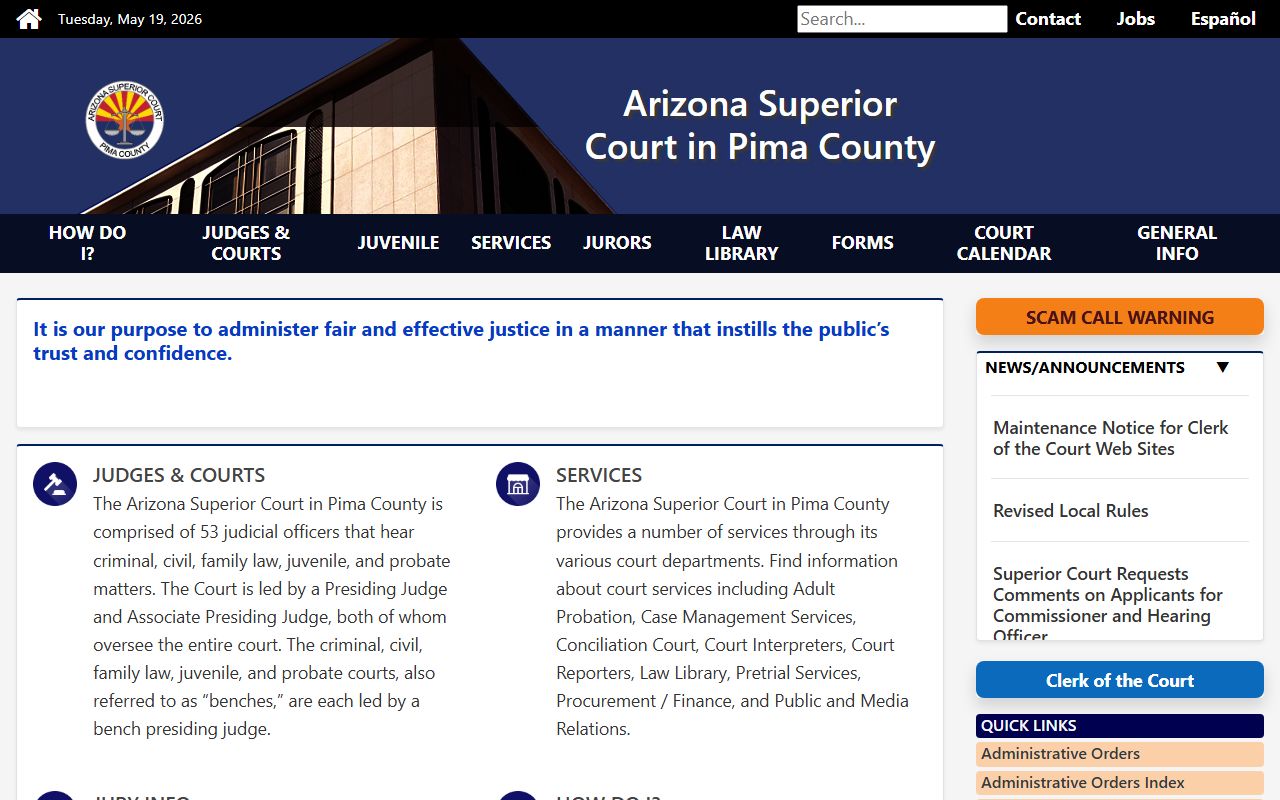
The Superior Court site lays out the bench structure and links to Judges & Courts, Court Calendar, and Services pages used by the public on a daily basis.
Arizona Superior Court in Pima County
110 West Congress Street
Tucson, AZ 85701
520-724-4200
Office of the Clerk of the Superior Court
110 W Congress St
Tucson, AZ 85701-1317
520-724-3200
Pima County Consolidated Justice Court
240 North Stone Avenue
Tucson, AZ 85701
520-724-3171
Types of Court Records Available in Pima County
Pima County Court records cover most case types heard in the state Superior Court and the local Justice Court. The Clerk groups its public records into Criminal, Civil, Family Law, Probate and Guardianship, and Marriage License files. Each group has its own filing counter, fee structure, and copy rules. Juvenile and Title 36 mental-health case files are routed to the Juvenile Court Clerk on Ajo Way, not to Public Records Services downtown.
A look at the Pima County Consolidated Justice Court records page shows how limited-jurisdiction matters are kept apart from Superior Court files. That page lists what is online, what is excluded, and how to make a written records request when needed.
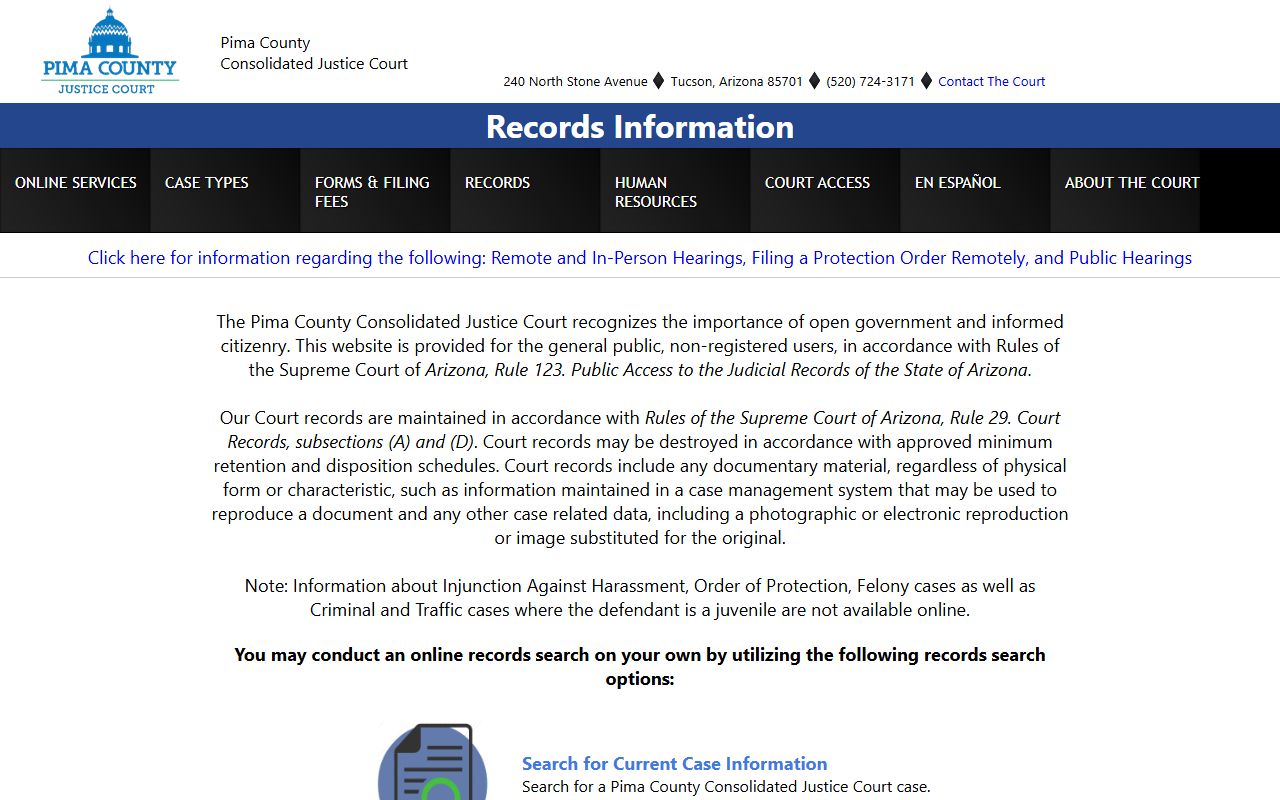
Justice Court keeps small claims, evictions, traffic, and most misdemeanor cases on its own server, with a separate online request form.
- Criminal records - Superior Court felonies; Justice Court misdemeanors and traffic; arraignments, pleas, sentences, and probation orders.
- Civil records - Superior Court major civil suits; Justice Court small claims, evictions, and lower-dollar disputes.
- Family law records - Divorce, legal separation, custody, child support, paternity, name change, and protective orders.
- Probate records - Wills, estates, guardianship, conservatorship, and trust matters.
- Juvenile records - Delinquency, dependency, severance, and adoption files, mostly restricted from public view.
- Traffic records - Justice Court citations, plus city magistrate court tickets, searched by ticket or case number.
What Pima County Court Records Show
A Pima County Court record is a case file. It is not a background check. The Clerk says plainly that the office does not provide background checks for public inquiries. Each case shows a set of fields that line up with the court's docket system. A public look at a sample Justice Court civil case shows the basic shape of the data: case number, filing date, status, judge, parties, events, and document list.
The fields below match what shows up on a typical Pima case display, drawn from the public sample at the Justice Court case search. A Superior Court file uses many of the same fields, with extra entries for orders, minute entries, and sealed exhibits.
| Field | What It Shows |
|---|---|
| Case Number | Court code plus year and serial number, like CV24-021838-RC or CR13-005195-MI. |
| Filing Date | The date the complaint or petition was filed, in MM/DD/YYYY form. |
| Case Status | Open, pending, disposed, closed, or sealed by court rule. |
| Assigned Judge | Judicial officer for the case, with bench and division number. |
| Parties | Plaintiff or state, defendant, attorneys, service dates, and answer dates. |
| Case Events | Date, time, matter type, event name, and result for each docket entry. |
| Documents | Document type, subtype, caption, and file date; some shown only at the courthouse. |
| Disposition | Verdict, plea, default judgment, dismissal, or other final result. |
Public Access Laws for Pima County Court Records
Court records in Arizona are open by default unless closed by law, court rule, or court order. The base rule for agency records is A.R.S. § 39-121, which says public records held by an officer are open during office hours. A.R.S. § 39-121.01 sets out who must keep records and how copy requests work. Court files use a parallel framework. The Arizona Supreme Court's Rule 123 sets access rules for judicial records. The Pima Clerk and the Justice Court both cite Rule 123 in their public-records pages.
The Clerk asks every requester to affirm a noncommercial purpose, or to state the commercial use, under A.R.S. § 39-121.03. That step is not optional. The same rule applies to many state and county agencies. Court access also varies by tool. A courthouse terminal, a public web docket, an eAccess document purchase, party ECR access, and an attorney ECR account can each show a different level of data.
The Pima County Clerk Public Records Search page is the office's main online tool. The page itself is up, but document access is paused under a maintenance notice through the week of June 8, 2026.
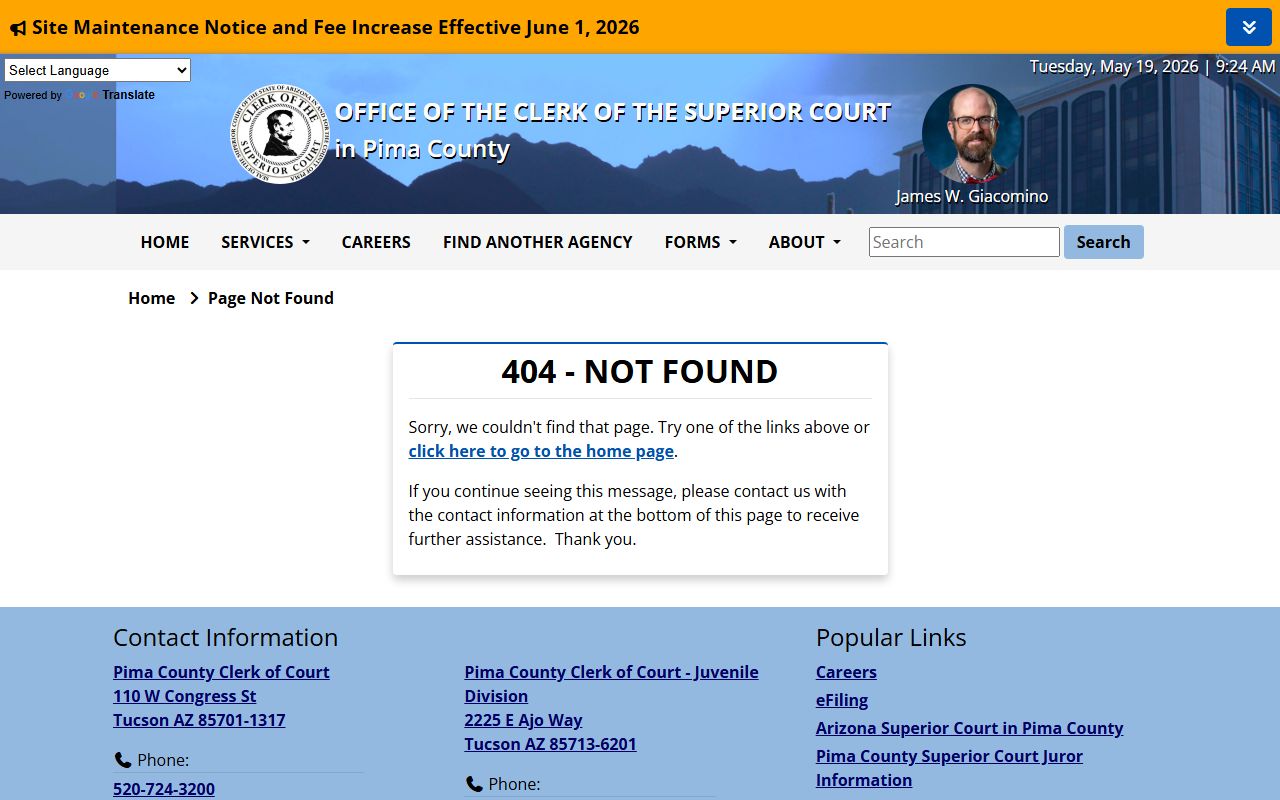
The page directs people to Public Records Services in Room 241 of the Congress Street complex during the outage.
Key statutes:
A.R.S. § 39-121 - Public records held by Arizona public bodies are open for inspection during office hours.
A.R.S. § 39-121.01 - Sets out record maintenance, copy rules, and the affirmation a requester must give.
A.R.S. § 39-121.03 - Sets a separate path for use of public records for sale, resale, or other commercial purpose.
A.R.S. § 13-911 - Allows eligible people to petition to seal arrest, conviction, and sentencing records.
A.R.S. § 41-1750 - Puts the central criminal-history records repository at the Arizona Department of Public Safety.
Records That Are Restricted or Confidential
Not every Pima County Court record is open. Sealed records, juvenile dependency, severance, adoption, and Title 36 mental-health files are closed by statute or court order. A.R.S. § 8-208 allows public access to many juvenile delinquency records but closes adoption, severance, and dependency files. Mental-health case documents are governed by A.R.S. § 36-509, which requires strict confidentiality.
Justice Court also keeps Injunction Against Harassment, Order of Protection, felony cases, and criminal or traffic cases with a juvenile defendant off its public web search. That does not mean no file exists. It means the public web tool will not show it. Protected addresses, victim identifiers, financial account numbers, and Social Security numbers are also redacted across most court systems. A person who wants a sealed record opened up usually needs to file a motion in the court that issued the seal.
Specialty Courts in Pima County
Pima County Superior Court runs problem-solving courts that focus on treatment and supervision. Drug Court works with eligible defendants whose substance use ties to their criminal cases. The program uses judicial monitoring, drug testing, treatment, and progress hearings. Judge Pro Tem Tracy Miller handles the Drug Court calendar.
Criminal Mental Health Court serves defendants with mental-health needs that connect to a criminal case. Judge Pro Tem Mark Hotchkiss is listed for that bench. Both programs aim to cut repeat offenses and connect people with services. Records for these courts are part of the underlying criminal case, and access tracks the public-access rules that apply to that case.
Outside the courts themselves, Pima County Justice Services runs a Safety and Justice Challenge program. It launched in 2015 and uses pretrial assessment and supervision, jail population review, pre-arrest deflection, warrant resolution, and improved court access. The Transition Center opened in 2023 to help people leaving the Pima County Jail line up jobs, housing, and treatment. The County Accessibility Rideshare Service gives rides to court for people who need them.
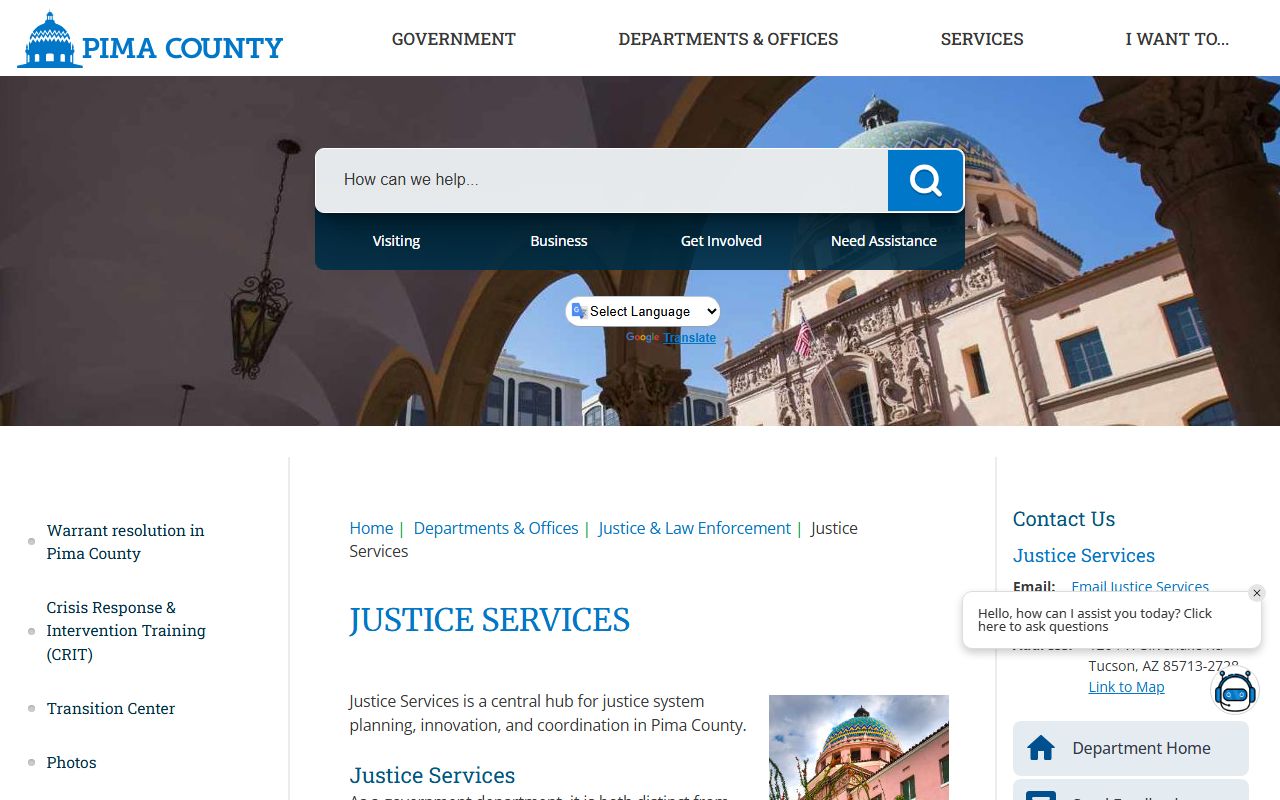
The Justice Services page ties these programs back to the courts that depend on them every week.
Pima County Sheriff and Jail
Sheriff Chris Nanos leads the Pima County Sheriff's Department. The headquarters is at 1750 E. Benson Highway, Tucson, AZ 85714. The main jail is the Pima County Adult Detention Complex at 1270 W. Silverlake Road. The Sheriff posts a free inmate lookup that searches the current jail roster by last name. The page warns that the roster only lists people in custody at the Adult Detention Complex right now.
Bonds, deposits, and visit check-in all happen at Silverlake Road, not at the downtown courts. Bond posting is at the Inmate Accounts Office in the main lobby. Surety bonds run 24 hours a day. Cash, credit, and debit run through lobby kiosks at the Main Jail Complex. No releases happen between 10 p.m. and 8 a.m. for security reasons.
The full roster, bond rules, and visit schedule are on the Pima County inmate records page. Active warrants and bench-warrant resolution are on the warrant records page. Recently released custody questions are on the released inmates page.
Marriage, Divorce, and Probate Records
The Clerk of the Superior Court issues Pima County marriage licenses at Civil and Family Support Services, Room 131A, 110 W Congress Street. A license costs $98 through May 31, 2026. Arizona does not require a blood test, and there is no waiting period. The license is valid for 12 months and can be used anywhere in the state. The Clerk also handles divorce filings in family law. Probate cases run through the Superior Court probate bench and the Clerk's Probate Support Services.
Marriage applications, divorce petitions, certified copies, and probate filings are detailed on the marriage and divorce records page and the probate records page. Many readers mix up the basic terms used in probate. A short list helps.
- Testator
- The person who made a will.
- Executor
- The person named in a will to settle the estate.
- Intestate
- A person who died without a valid will; Arizona statute then sets the order of heirs.
- Guardian
- A court-appointed person who looks after a minor or incapacitated adult.
- Conservator
- A court-appointed person who manages money or property for someone who cannot.
Pima County Court Records Fees
The Clerk posts a current fee schedule and a separate schedule that takes effect June 1, 2026 under Pima County Ordinance 2026-4. Filing-fee payment is taken in cash, money orders, cashier checks, personal checks, MasterCard, Visa, Discover, and debit cards. Credit cards are taken over the phone for copy requests, including postage and handling. The base copy and marriage-license items below come from the 2025 schedule posted by the Clerk.
| Item | Amount |
|---|---|
| Marriage license | $98.00 through May 31, 2026 |
| Certified copy of marriage license or application | $35.00 through May 31, 2026 |
| Notary service | $8.00 through May 31, 2026 |
| Postage and handling | $8.00 through May 31, 2026 |
| Justice Court plain copy per page | $0.50 |
| Justice Court certified copy | $33.00 per document |
Filing fees for civil, probate, and domestic relations cases rise on June 1, 2026 under the new ordinance. The Clerk fee schedule page hosts the current PDF and the June 1 update side by side. Confirm the current amount before paying.
How to Interpret Pima County Court Records
Pima County Court records use a steady set of docket labels. A "Default Judgment" entry means the court ruled because a party did not answer or appear after proper service. A "Disposed" status means the case is closed for processing, but a file can still hold post-judgment motions. A "Set Aside" relates to relief under A.R.S. § 13-905, which can set aside a guilty judgment without erasing the record.
Charges and convictions are not the same. A charge is an accusation. A conviction is a finding of guilt by plea, verdict, or court order. A bench warrant is issued by a judge, often after a missed court date. An arrest warrant comes from probable cause. Sealing under A.R.S. § 13-911 removes the record from most public view going forward. Marijuana expungement under A.R.S. § 13-3981 is a narrow remedy for qualifying offenses.
Note: Online docket data is not the same as a certified record, and the Clerk and Justice Court both warn online data may be changed, updated, or out of date.
Accuracy and Record Limitations
Pima County Court records are updated by the Clerk and the Justice Court on a rolling basis. The Clerk asks for three business days after a filing before a document appears online. Older Justice Court cases may have been destroyed under retention rules tied to Arizona Supreme Court Rule 29. The Clerk's maintenance banner makes another point clear: an online tool may be unavailable while paper records remain open in person.
An online case page is a research tool. It is not a certified copy. To use a record in a legal, employment, immigration, or licensing setting, request a certified copy from the Clerk or the Justice Court. The Clerk does not provide background checks. The Arizona Department of Public Safety is the central state criminal-history repository under A.R.S. § 41-1750, and its process is separate from a court docket search.
Note: Confirm the case status with the Clerk or the issuing court before you rely on online data for a hearing, an appeal, or any official filing.
History of Pima County Courts
Pima County is one of the four original counties of the Arizona Territory. The historic Pima County Courthouse on Church Avenue, with its tiled dome and Spanish Colonial Revival face, is a landmark in downtown Tucson. The Superior Court and the Clerk moved court business into the modern complex at 110 West Congress Street, while the old courthouse now serves as a heritage and museum site.
Court technology has moved with the building. The Arizona Judicial Branch eAccess system covers Superior Court civil and criminal cases statewide from July 1, 2010 forward. Pima County criminal records on eAccess start with cases filed on or after July 1, 2015. That cut-off is worth knowing when an older case is the target of a search.
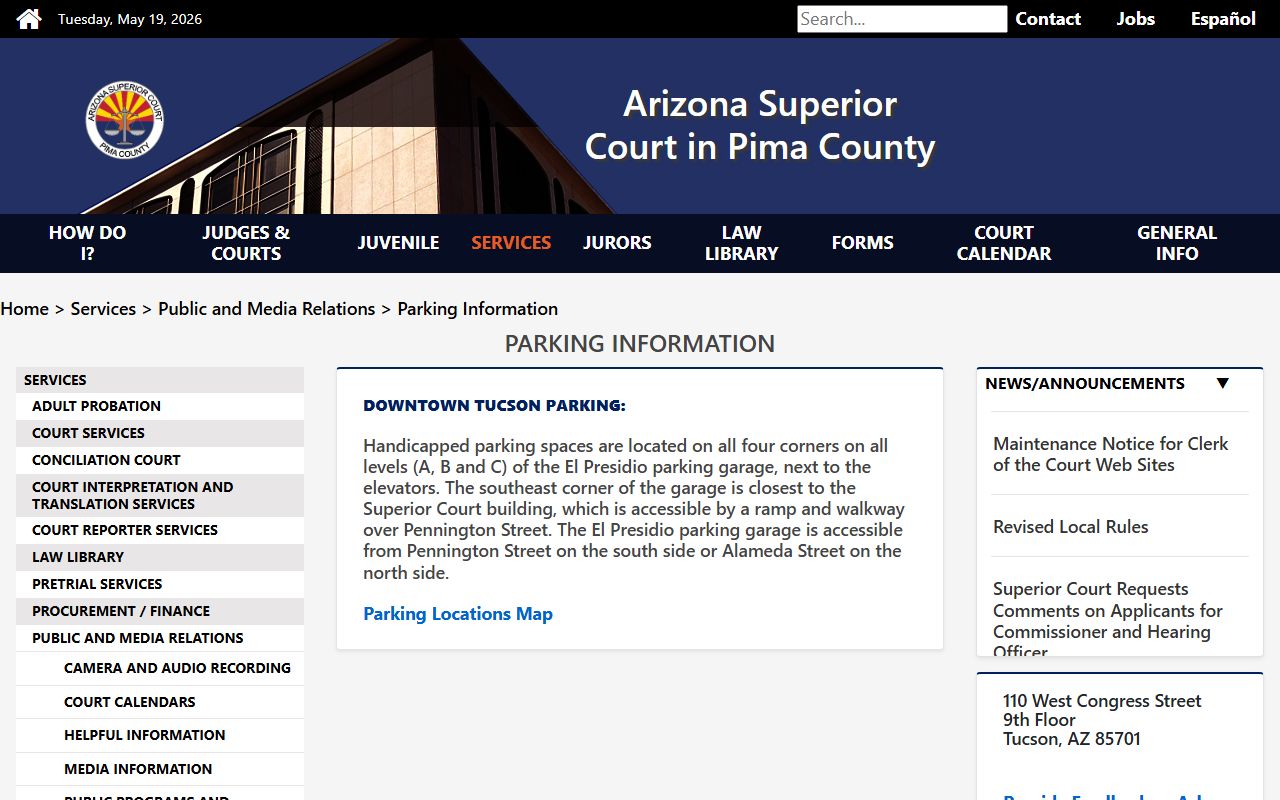
The court keeps practical visitor pages, like the El Presidio parking guide, up to date for the people who still need to come to the building.
Frequently Asked Questions
How do I look up a Pima County Court case online?
Use the Clerk's case records page for Superior Court matters and the Justice Court records page for small claims, evictions, traffic, and most misdemeanors. The Clerk page links to Public Record Search, ECR for Parties, ECR for Attorneys, and Arizona eAccess. The Justice Court page hosts a live case search by case or citation number. Public Record Search documents are offline through the week of June 8, 2026 under a maintenance notice.
Are online Pima County Court records certified?
No. Both the Clerk and the Justice Court say online data is not an official court record. The data may be changed, updated, or out of date. For court, work, or housing, order a certified copy from the Clerk's Public Records Services, Room 241, 110 W Congress Street. Order by phone, in person, by email, or by mail. The Clerk takes credit cards over the phone for copies and postage.
Does the Clerk run background checks?
No. The Clerk explicitly says the office does not run background checks for public inquiries. A court file lists case-level data. A statewide criminal-history check runs through the Arizona Department of Public Safety under A.R.S. § 41-1750 and uses a separate fingerprint-based process. More detail is on the criminal records page.
More on the Pima County Court Records FAQ page.