
Probate Court in Pima County
Pima County Superior Court runs a probate bench. The Probate Court page on the Superior Court site introduces the bench and its work. Presiding Judge Sandra Bensley, Division 15, leads probate. Judge Lisa Abrams, Division 30, also sits in probate. Commissioners and hearing officers handle many guardianship and conservatorship calendars.
The probate bench shares the downtown Superior Court complex at 110 West Congress Street with the criminal, civil, family, and juvenile benches. Hearings are scheduled through the assigned division. The court's daily calendar shows probate hearings by date, division, and judge.
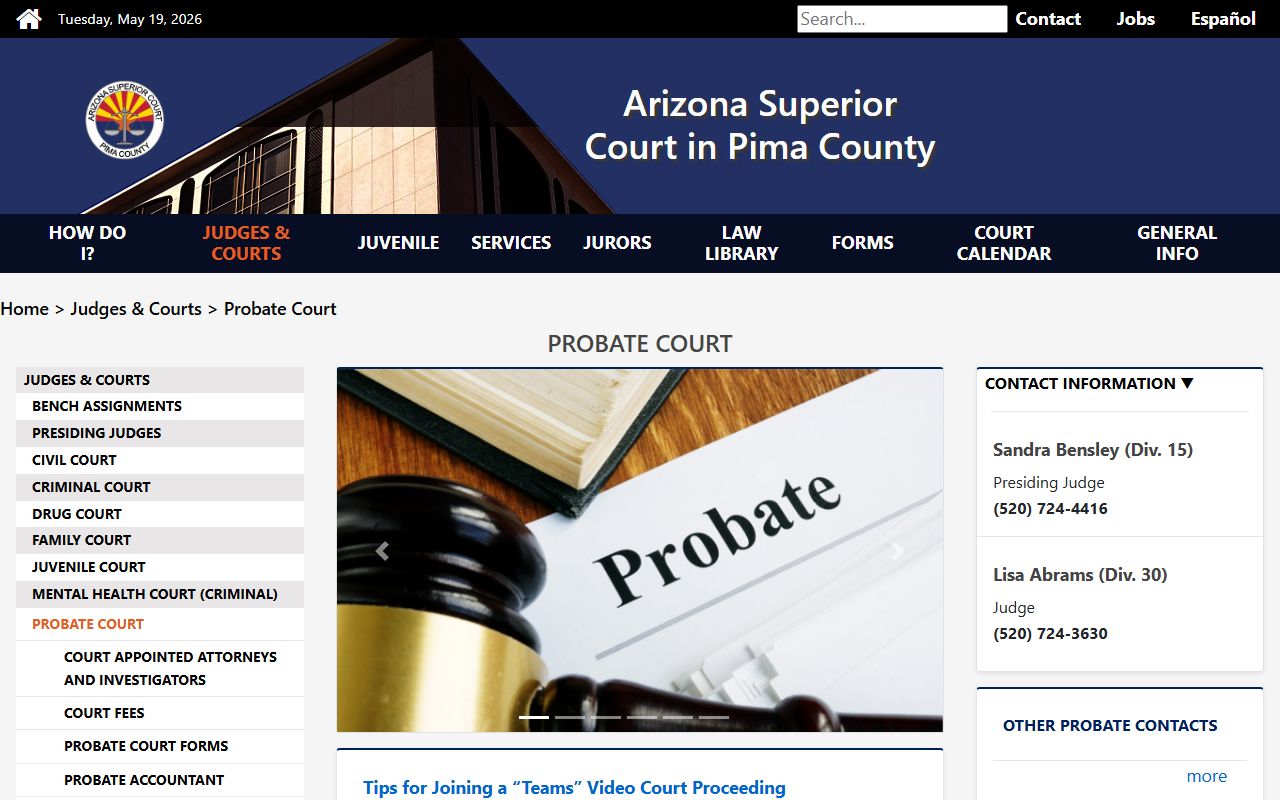
The Probate Court page links to bench resources, hearing information, and self-help routes.
Pima Probate Support Services
The Clerk's Probate Support Services is the practical intake office. It handles probate filings, case-processing questions, and probate-specific copy work. The Clerk fee schedule includes probate filing fees, with the June 1, 2026 fee increase under Pima County Ordinance 2026-4 applying to civil, probate, and domestic relations cases.
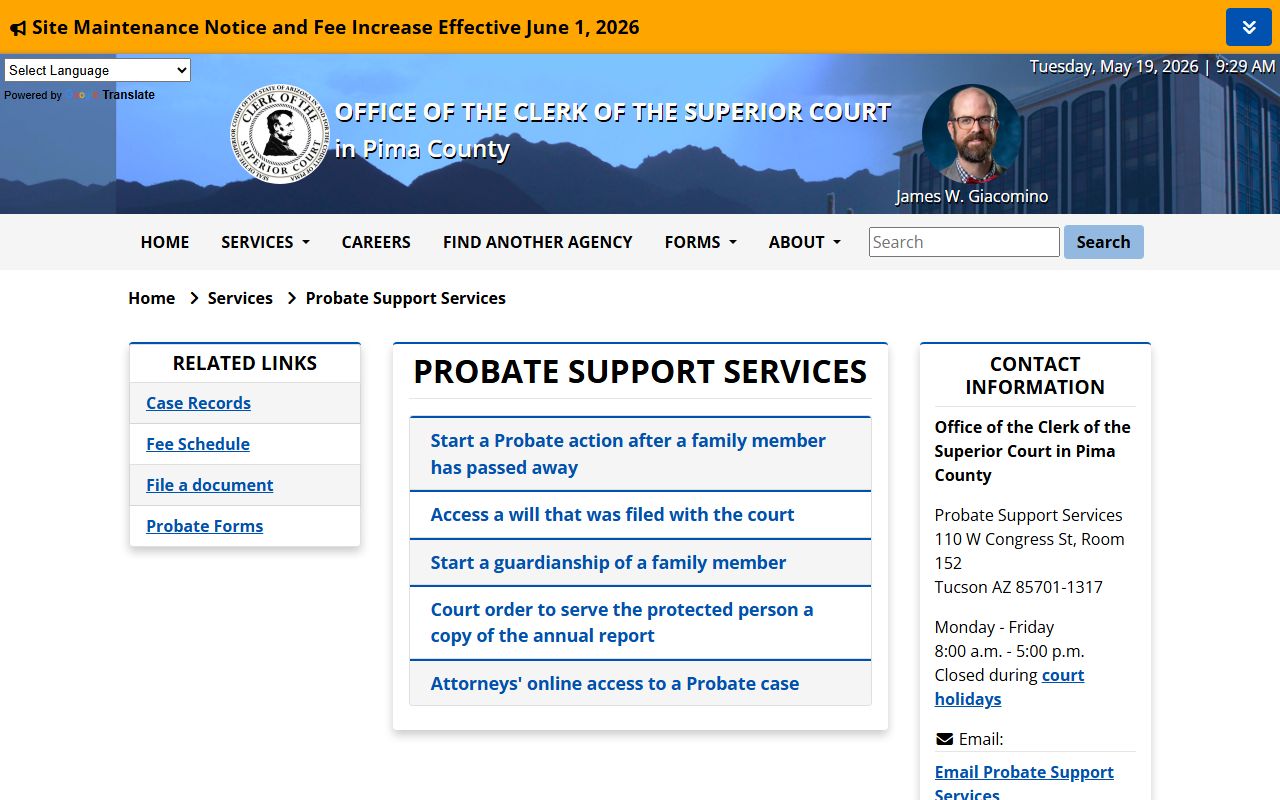
The Clerk's Probate Support Services page lists contact paths and supported filings.
Probate Support Services
110 W Congress St
Tucson, AZ 85701-1317
520-724-3200
Filing and case-processing help
Public Records Services
110 W Congress St, Room 241
Tucson, AZ 85701-1317
520-724-3240
Copies of probate orders and decrees
Types of Pima County Probate Filings
Pima County probate records cover several distinct case types. Each has its own filing requirements, notice rules, and confidentiality limits. The Clerk's probate forms library hosts the official forms.
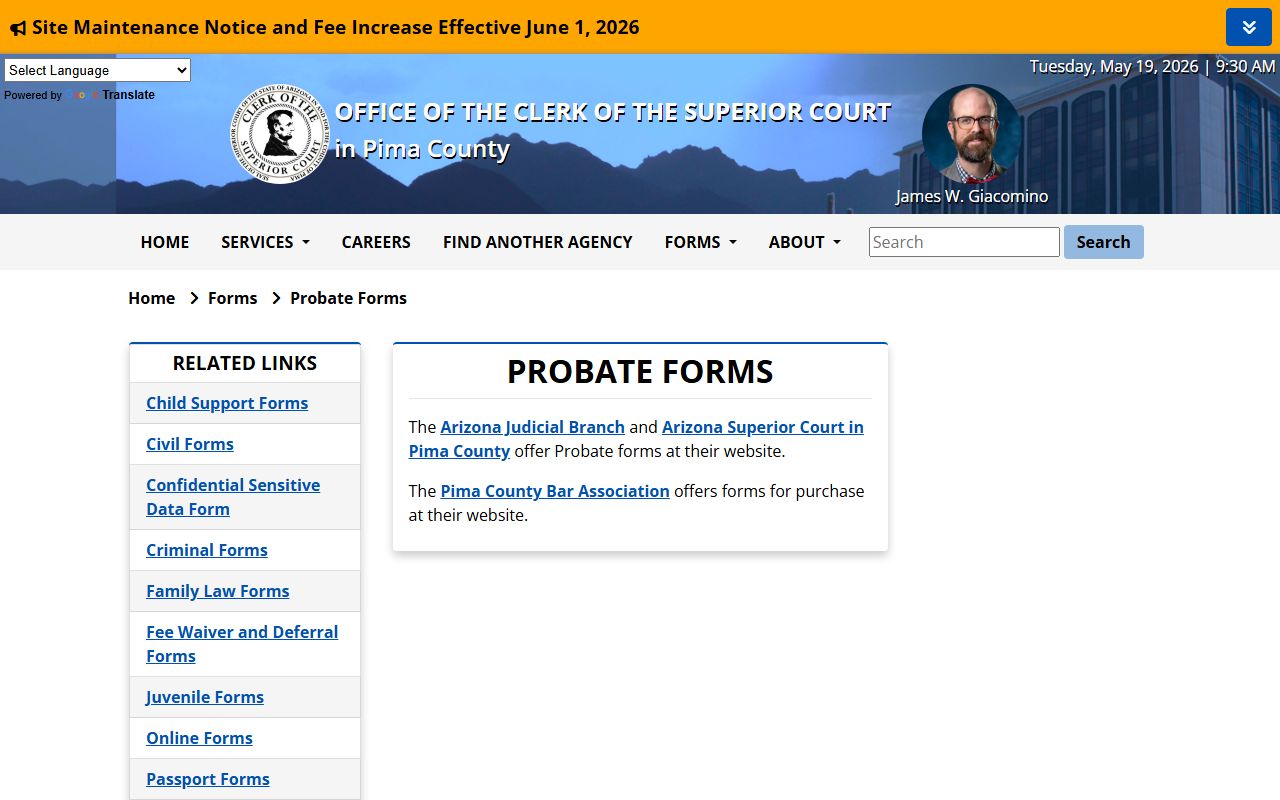
The forms library groups family-law, civil, probate, juvenile, and other categories used by Pima County filers.
- Formal probate - Full court oversight of a decedent's estate.
- Informal probate - Simpler administration when heirs and creditors agree on the path.
- Small estate affidavit - A non-formal collection path under A.R.S. § 14-3971.
- Guardianship - Court oversight for a minor or incapacitated adult.
- Conservatorship - Court oversight of money and property for a protected person.
- Trusts - Trust contests, accountings, and other trust matters.
- Adult protective proceedings - Filings related to vulnerable adult protection.
Pima County Probate Record Search
To search Pima County probate records, use the Clerk's case records page. Public Record Search gives limited public viewing. ECR for Parties lets eligible parties access their own probate case with an Arizona driver's license. Arizona eAccess covers many Superior Court probate filings statewide, with document fees.
The Clerk maintenance banner says ECR for Attorneys, ECR for Parties, and Public Record Search documents are temporarily unavailable online until the week of June 8, 2026. For probate documents during that window, use Public Records Services in Room 241 of 110 W Congress Street.
| Tool | Field | Notes |
|---|---|---|
| Public Record Search | Case number, party name | Limited viewing; document access paused. |
| ECR for Parties | Login | Most parties with an Arizona driver's license. |
| Arizona eAccess | Account; case or event search | Per-document fee or subscription. |
| In-person at Public Records Services | Case number, name | Walk-in copies; call 520-724-3240 ahead. |
Small Estates Under A.R.S. § 14-3971
Arizona offers a simpler path for some Pima County estates. A.R.S. § 14-3971 governs collection of personal property by affidavit for small estates. The statute sets eligibility, waiting periods, and the affidavit content. Dollar thresholds in the statute change over time, so confirm the current threshold before filing.
A small estate affidavit can transfer some personal property without opening a formal probate case. Real property has separate rules. The affidavit is presented to the bank, broker, or holder of the asset, not to the court. The Clerk does not certify a small-estate affidavit as a court order.
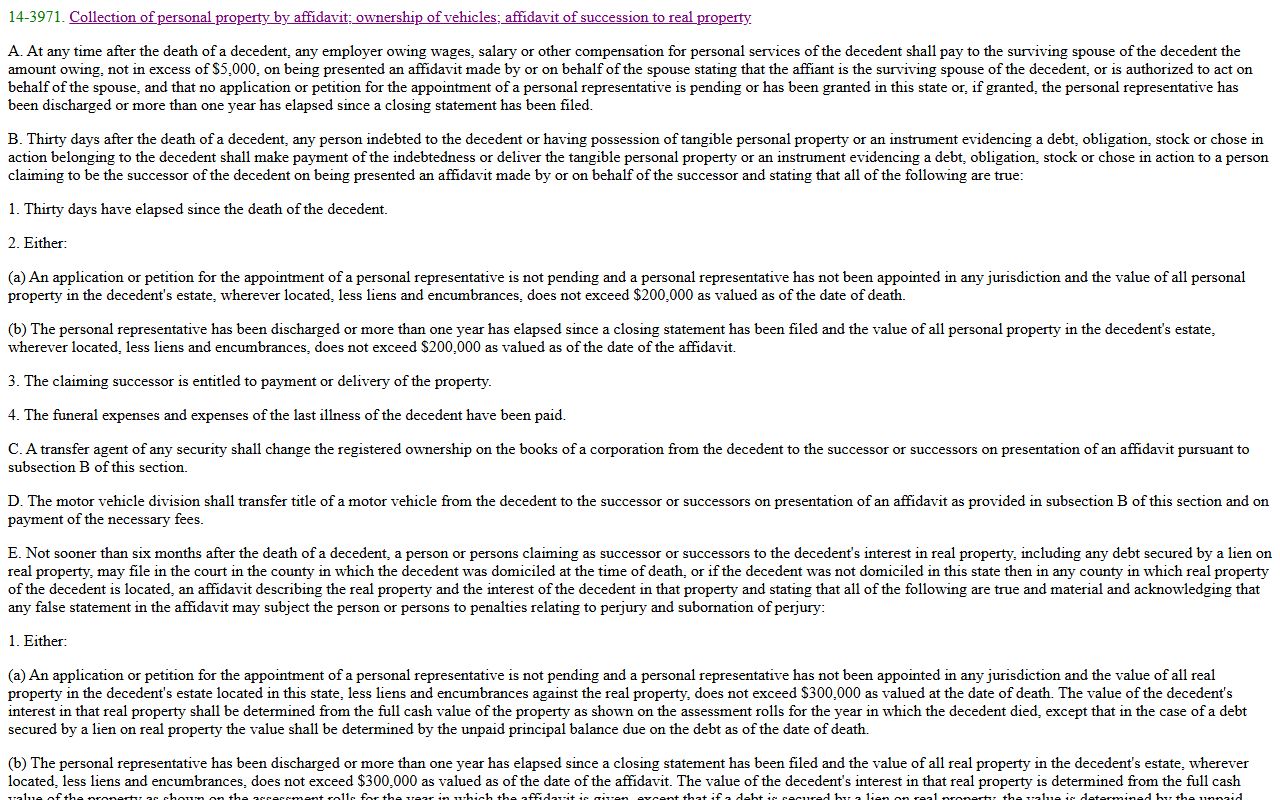
The statute is the legal basis for many no-formal-probate cases in Pima County, especially for modest personal-property estates with no real estate.
An heir who plans to use a small-estate affidavit should still consider whether real property, a contested claim, or a creditor dispute will pull the estate into a formal probate. The court's case-records search will not show a small-estate affidavit because the affidavit is not filed with the court.
Pima County Probate Filing Fees
Probate filing fees in Pima County come from the Clerk fee schedule. The 2025 schedule applies through May 31, 2026. A new schedule takes effect June 1, 2026 under Pima County Ordinance 2026-4 for civil, probate, and domestic relations cases. Payment is by cash, money orders, cashier checks, personal checks, MasterCard, Visa, Discover, and debit cards. Returned personal checks are referred to the County Attorney's Office for collection.
| Item | Source |
|---|---|
| Probate filing fee (formal or informal) | See current Clerk fee PDF |
| Guardianship and conservatorship filing fee | See current Clerk fee PDF |
| Certified copies | See current Clerk fee PDF |
| Fee waiver or deferral | Use Clerk fee waiver and deferral forms |
| June 1, 2026 fee changes | Pima County Ordinance 2026-4 |
Note: Confirm the current probate filing fee on the Clerk fee schedule page before filing; the schedule updates twice in 2026.
Probate Definitions
Probate uses a set of legal terms that matter when reading a Pima County probate record. A short glossary helps a first-time reader follow the docket and the orders.
- Testator
- The person who made a will.
- Executor
- The person named in a will to settle the estate.
- Personal representative
- The Arizona term for the person, named in a will or appointed by the court, who administers an estate.
- Intestate
- A person who died without a valid will.
- Heir
- A person entitled to inherit when there is no will, under Arizona statute.
- Devisee
- A person who receives property under a will.
- Guardian
- A court-appointed person who looks after a minor or incapacitated adult.
- Conservator
- A court-appointed person who manages money or property for a protected person.
How Probate Works in Pima County
A Pima County probate case starts with the right filing for the case type. Wills are filed with the Clerk. The court reviews the petition, appoints a personal representative, and oversees notice to heirs and creditors. The personal representative inventories the estate, manages claims, files an accounting, and distributes assets.
- Decide which path fits: formal probate, informal probate, small estate affidavit, guardianship, or conservatorship.
- Pull the right forms from Pima Clerk probate forms or Arizona Judicial Branch forms.
- File the petition with the Clerk by eFiling, mail, or counter as eligible.
- Pay the probate filing fee or submit a fee waiver or deferral.
- Provide required notices to heirs, devisees, creditors, and interested persons.
- Attend probate hearings if the matter is contested or if a guardian or conservator is needed.
- File the inventory, accounting, and final documents as required by the court.
- Request copies or certified copies from Public Records Services as needed.
Guardianship and Confidentiality
Guardianship and conservatorship case files often include medical and personal data tied to a protected person. Those filings can be restricted by court rule, court order, or Arizona statute. Mental-health-related filings under Title 36 are handled separately by the Juvenile Court Clerk on Ajo Way. Public Records Services should be called before visiting if the case is a guardianship or conservatorship.
The Arizona small-estate affidavit threshold and many probate procedural rules are tracked in A.R.S. § 14-3971 and related Title 14 sections. Pima Clerk staff cannot give legal advice on which form to use.
For a guardianship or conservatorship case, expect more redactions in the public file. Account information, medical assessments, and protected addresses are typical confidential items. A request to view restricted material may require a court order or a showing of standing.
Certified Copies of Pima Probate Records
Certified copies of a Pima County probate order or decree come from Public Records Services in Room 241 of the Congress Street complex. The Clerk accepts copy requests by phone, in person, email, mail, or online. For phone requests, the Clerk takes Visa, MasterCard, or Discover for the copy and the postage and handling. A noncommercial-purpose affirmation is required for each copy request under A.R.S. § 39-121.01.