
Pima County Marriage License Office
The Office of the Clerk of the Superior Court runs Civil and Family Support Services in Room 131A at 110 W Congress Street. The office issues Pima County marriage licenses, takes civil and family filings, processes name changes, accepts protective-order petitions, and handles passports by appointment. The hours are Monday through Friday 8:00 a.m. to 5:00 p.m., with passports by appointment 8:30 a.m. to 3:00 p.m.
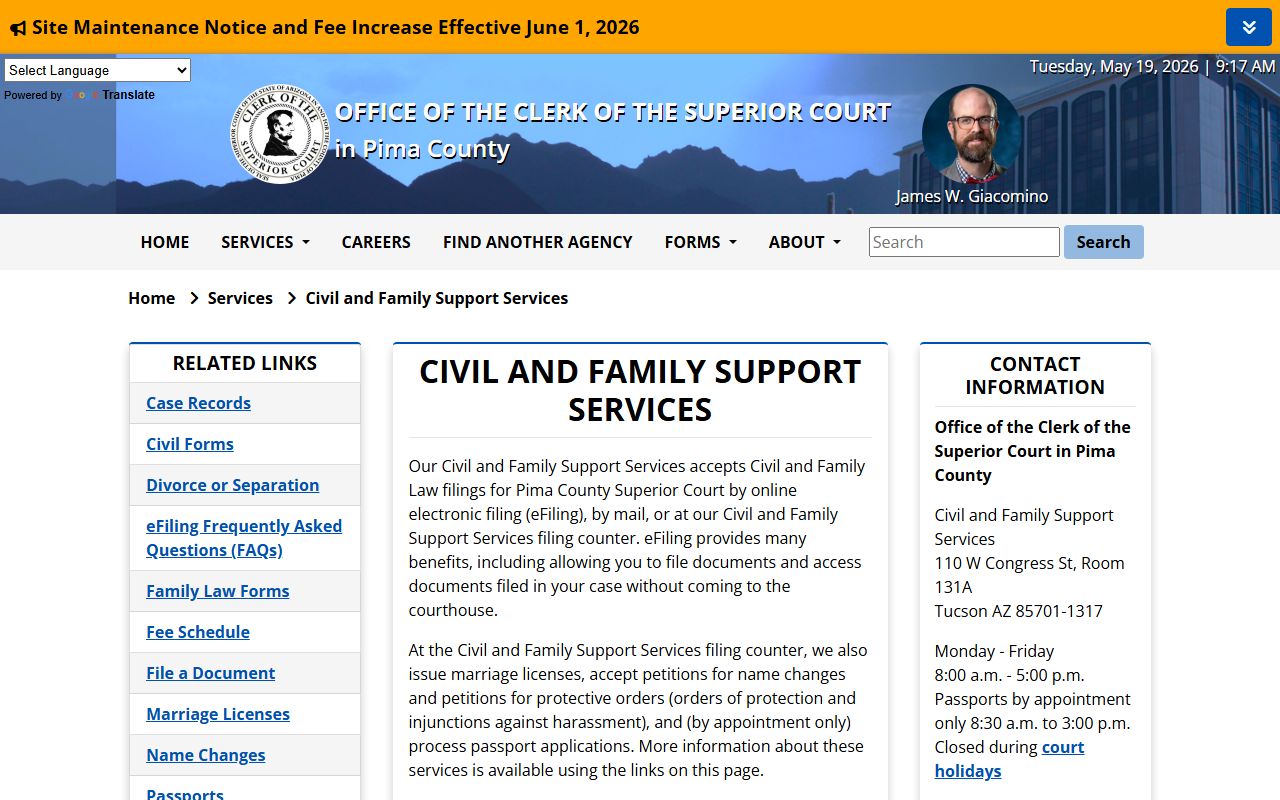
The Clerk's Civil and Family Support Services page covers the in-person kiosk process, the queue system, and the marriage clerk phone line at 520-724-3206.
Civil and Family Support Services
110 W Congress St, Room 131A
Tucson, AZ 85701-1317
520-724-3210
Marriage clerk 520-724-3206
Mon-Fri 8:00 a.m.-5:00 p.m.
How to Apply for a Pima County Marriage License
Both parties normally appear in person at the Clerk's office. Each fills out kiosk information in the Civil and Family lobby, pays the fee, and signs an affidavit. A form of identification is strongly encouraged for each party. No witnesses are needed for issuance of the license.
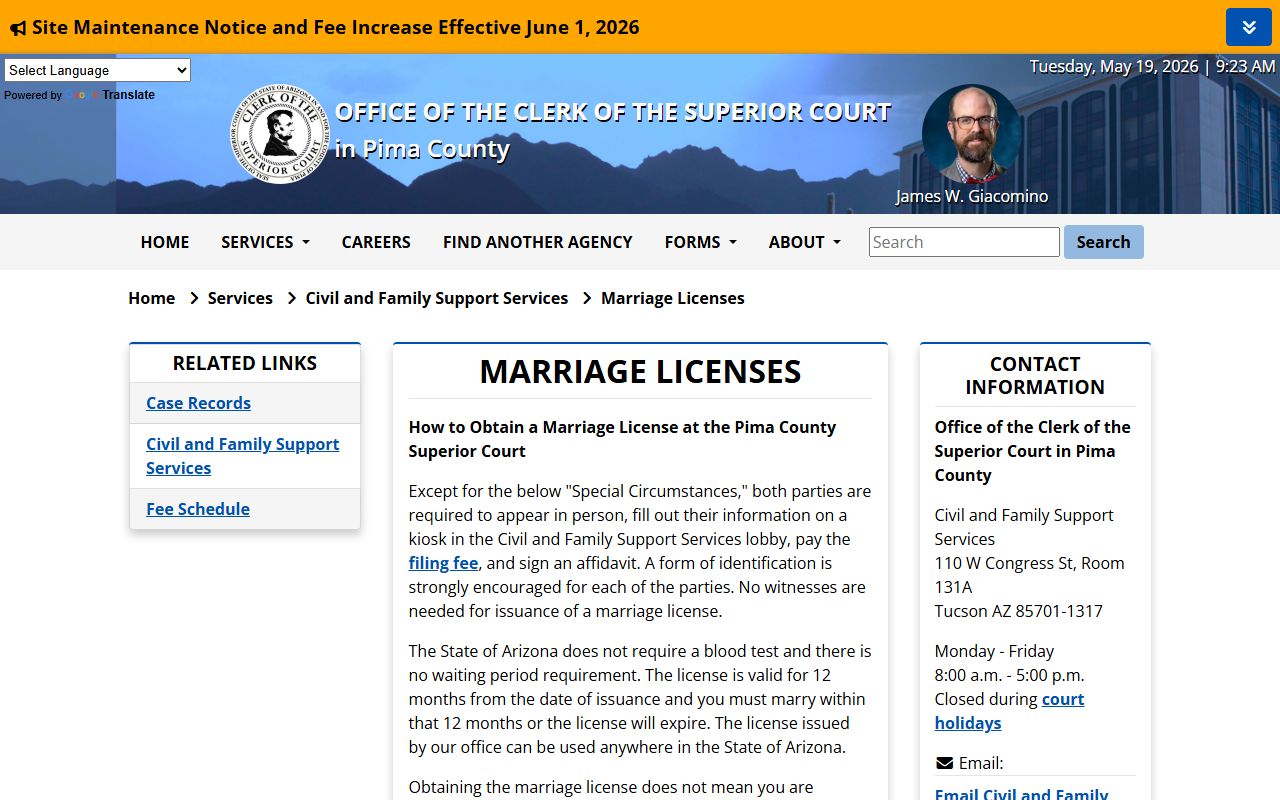
The Clerk's marriage license page sets the rules, including special-circumstances by mail or email.
- Both parties arrive at Civil and Family Support Services, Room 131A.
- Each party fills in kiosk fields with name and personal data.
- Bring identification for each party.
- Pay the marriage license fee at the counter.
- Sign the affidavit before a deputy clerk.
- Receive the license; use it anywhere in Arizona within 12 months.
- An authorized officiant signs the Record of Marriage after the ceremony.
- The officiant returns the signed Record of Marriage within 30 days.
Arizona does not require a blood test, and there is no waiting period.
Pima Marriage License Application Field Inventory
The Pima County marriage license process uses kiosk fields rather than a single paper form for the public. The fields below are the data points the Clerk needs to issue a license. Bring this information in writing if you want to move through the queue faster.
| Field / Step | Type | Required | Notes |
|---|---|---|---|
| Party 1 information | Kiosk text fields | Yes | Name, date of birth, address, and other ID data. |
| Party 2 information | Kiosk text fields | Yes | Both parties normally appear in person. |
| Affidavit signature | Signature | Yes | Signed at the Clerk; special-circumstance absent party signature must be notarized. |
| Identification | Document | Strongly encouraged | Each party should bring a current photo ID. |
| Fee payment | Cash, card, money order, or check | Yes | Marriage license fee is $98 through May 31, 2026. |
| Under-18 consent or emancipation | Notarized statement or proof | Conditional | Age 16 or 17 only; spouse age gap limit applies. |
| Officiant return | Signed Record of Marriage | Post-ceremony | Must be returned within 30 days. |
Pima County Marriage License Fees
The Clerk posts a current fee schedule and a separate schedule effective June 1, 2026 under Pima County Ordinance 2026-4. Filing-fee payment is taken in cash, money orders, cashier checks, personal checks, MasterCard, Visa, Discover, and debit cards. Credit cards are taken over the phone for copy requests, including postage and handling.
| Item | Amount |
|---|---|
| Marriage license | $98.00 through May 31, 2026 |
| Certified copy of marriage license or application | $35.00 through May 31, 2026 |
| Notary service | $8.00 through May 31, 2026 |
| Postage and handling | $8.00 through May 31, 2026 |
| June 1, 2026 fee changes | See current PDF on the Clerk fee schedule page |
Note: Confirm the current Pima County marriage license fee on the Clerk's fee schedule page before paying, since the schedule updates twice in 2026.
Special Circumstances
If an applicant is incarcerated, incapacitated in a hospital, in the military, or otherwise unable to appear together in person, the Clerk's marriage page allows a special-circumstance process. Call the marriage clerk at 520-724-3206 to request an affidavit for the marriage license by mail or email. The absent applicant signs the affidavit before a notary. The other applicant brings the notarized affidavit in person to Civil and Family Support Services and completes kiosk information for both parties.
Each special-circumstance request is reviewed by the Clerk. The marriage clerk may ask for documents that show the reason a party cannot appear. Plan ahead because the process takes longer than a standard walk-in.
Under-18 Marriage Rules
Arizona prohibits marriage by any person under 16. Legal consent age is 18. A person age 16 or 17 may marry only if the prospective spouse is no more than three years older and the under-18 person is emancipated or the custodial parent or guardian consents. Consent may be given by a subscribed, sworn, and notarized statement that names both applicants and grants permission. If parents are divorced or legally separated, the legal custodial parent must consent. Proof of custody may be requested.
These rules track Arizona statute. The Clerk's marriage page sets out the local intake process and refers requesters to A.R.S. § 25-121 for license issuance and A.R.S. § 25-124 for who may solemnize a marriage.
Ceremony and Return of the Record
Obtaining a Pima County marriage license does not mean the couple is married. A Justice of the Peace, clergy member, or other authorized person under A.R.S. § 25-124 must perform a ceremony and sign the license. The person performing the ceremony, both applicants, and two witnesses over age 18 must sign the marriage license. The officiant returns the completed and signed Record of Marriage within 30 days to the Clerk's Office at Civil and Family Support Services-Room 131A, 110 W Congress Street, Tucson, AZ 85701.
The license is valid for 12 months from the date of issuance. A couple must marry within that 12 months or the license expires. A license issued by the Pima Clerk can be used anywhere in Arizona.
Other Pima County Marriage License Locations
Several Pima County courts outside the downtown Clerk also issue marriage licenses. Each location follows the same statewide rules but may have its own hours and intake process.
- Ajo Justice Court
- Green Valley Justice Court
- Marana Municipal Court
- Sahuarita Municipal Court
- Oro Valley Magistrate Court
Call the local court ahead of time to confirm hours and bring identification for each party.
Divorce Filing in Pima County
Divorce and dissolution cases in Pima County run through Superior Court family law. The Clerk's Civil and Family Support Services accepts family law filings by eFiling, by mail, or at the counter. Attorneys and legal paraprofessionals must eFile. Self-represented litigants can use Arizona Judicial Branch self-service forms and the Clerk's family law forms.
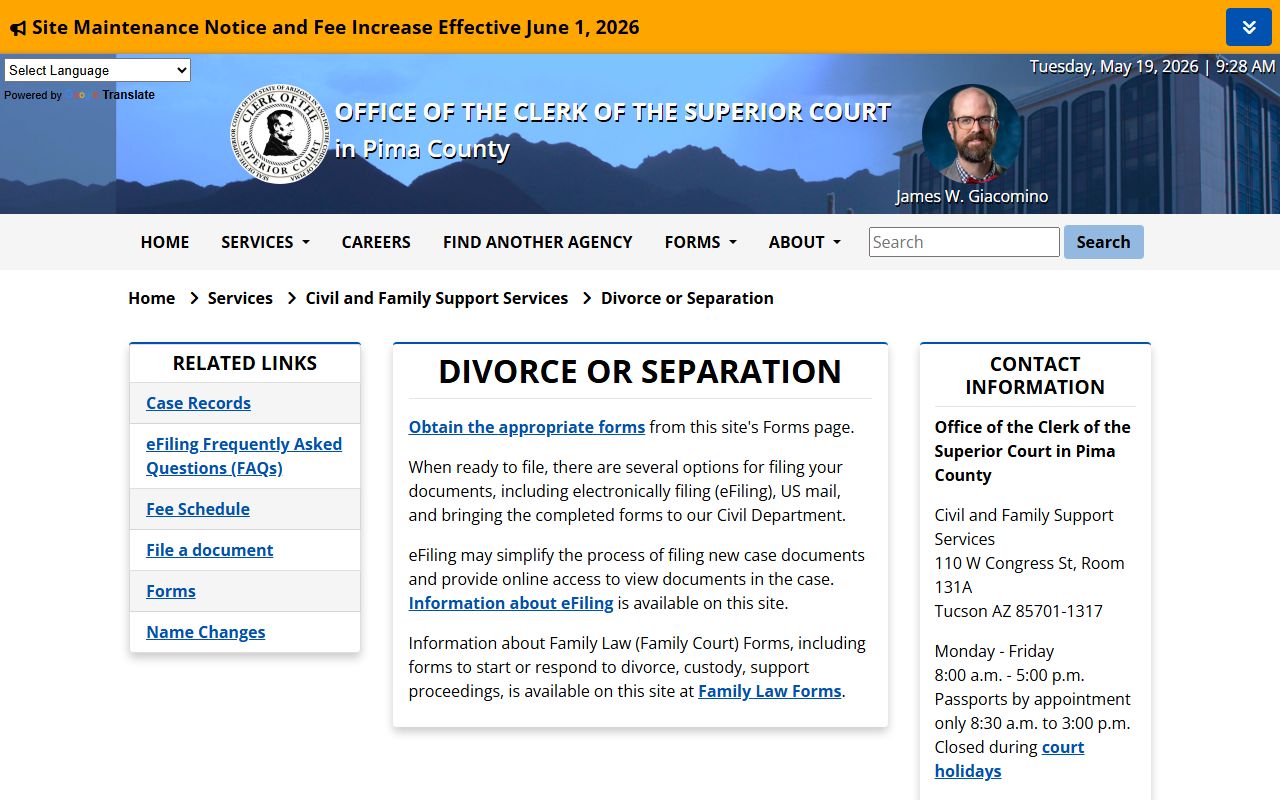
The Clerk's divorce or separation page covers the in-county process for petitions, decrees, and related filings.
- Review Arizona Judicial Branch self-service divorce forms and Pima Clerk family law forms.
- Prepare petition, summons, preliminary injunction, sensitive-data sheet, and child forms where children are involved.
- File through eFiling where required, or at Civil and Family Support Services, Room 131A.
- Pay the filing fee or file fee waiver or deferral forms.
- Serve the other party under the rules of civil procedure.
- Track hearings and orders through the case record or ECR if eligible.
- Request certified copies of any decree or order through the Clerk.
Divorce Record Search and Certified Copies
Divorce records are Superior Court family cases, kept by the Clerk of the Superior Court. To look up a Pima County divorce record online, use the Clerk's case records page. Public Record Search, ECR for Parties, ECR for Attorneys, and Arizona eAccess each offer a different cut of the file. Many sensitive items, including financial data and child information, are sealed or redacted.
Arizona dissolution findings are governed by A.R.S. § 25-312. The statute covers grounds, residency, and conciliation. For certified copies of a divorce decree, use Public Records Services at 110 W Congress Street, Room 241, phone 520-724-3240. The office takes phone, in-person, email, mail, and online requests.
Note: A divorce decree is the legal proof of dissolution; the Clerk's certified copy is the document most third parties require.